
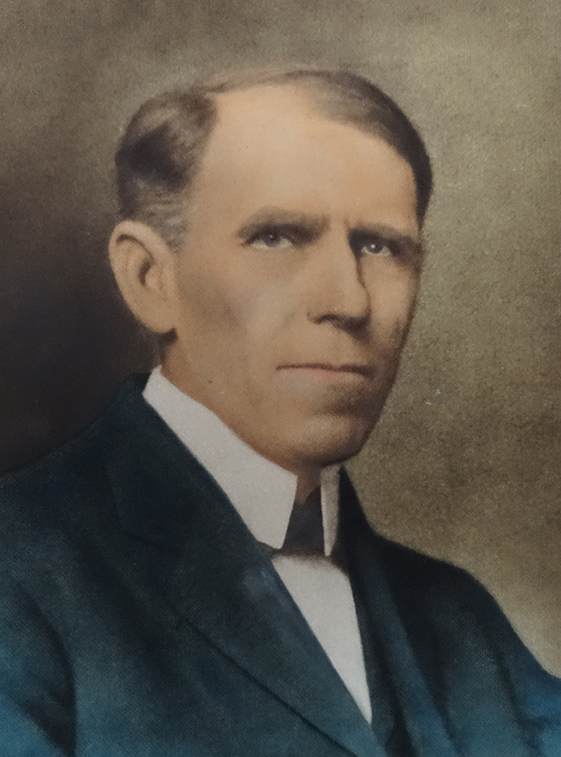
In 1900, a new City Charter was enacted, creating a bipartisan board of four commissioners to replace the old City Council. As former Mayor George I. Neal, one of the architects of the change, argued, the hope was that the bipartisan nature of the new commission – and a limit of no more than two commissioners from the same party -- would avert much of the controversy and turmoil that too often had marked the city’s affairs.
The commissioners would be elected by the voters and the commissioner receiving the most votes would become the mayor. In 1909, in the first election under the new plan, Rufus Switzer emerged as mayor.
Born in 1855, Switzer attended Marshall College, briefly taught school, and then studied law at the University of Virginia, graduating in 1881. He practiced law in Putnam County for 10 years. He moved to Huntington in 1891 and immediately involved himself in the city’s politics, winning election to City Council.
The year before Switzer became mayor the city had purchased a tract of land along Four Pole Creek as the site for a new incinerator. Not surprisingly, some of the site’s neighbors objected and a real donnybrook ensued. As mayor, Switzer settled the matter by declaring that the purchased property would become a park -- the city’s first ever. Although Switzer was the driving force behind the park, it was named Ritter Park when businessman C.L. Ritter donated two tracts of land that significantly enlarged it.
It was during Switzer’s first term as mayor that residents in Guyandotte and Central City, then independent communities, were persuaded to be annexed into Huntington. His first term also saw the purchase of a site on the northeast corner of 5th Avenue and 8th Street for construction of a badly needed new City Hall. It was completed late in 1914 and occupied early in 1915.
Switzer was 91 when he died in 1947.

